

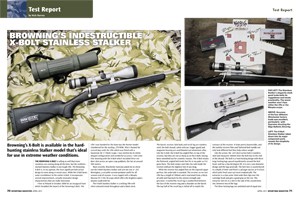

Browning’s X-Bolt is available in the hard-hunting Stainless Stalker model that’s ideal for use in extreme weather conditions.
The Browning X-Bolt is selling so well that more variations are coming along all the time, but the synthetic-stocked Stainless Stalker is one tough rifle. The Browning X-Bolt is, in my opinion, the most significant bolt-action design to come along in recent years. While the X-Bolt bears some resemblance to the earlier A-Bolt, it incorporates several improvements, actually innovative design characteristics that are really functional.
I flew to Poland in October 2008 for an inaugural hunt which heralded the launch of the Browning X-Bolt. The rifle I was handed for the hunt was the Hunter model chambered for the sizzling .270 WSM. After I hunted for several days with the rifle which was fitted with a Swarovski Z6 1.7-10×42 scope, I was smitten by its slimly elegant configuration and wonderful accuracy. I did some fine shooting with the X-Bolt which included three roe deer shot across an open crop paddock, the last at around 500 metres.
More recently, Winchester Australia asked me to check out the X-Bolt Stainless Stalker and sent me one in .223 Remington, a versatile varmint-predator outfit for all seasons and all reasons. It was topped with a Meopta Meostar R1 3-10x 50 scope which offers the brightest optics anyone could wish for.









0 Comments