


Hanging tightly to the handle by the cabin, my stomach gave a bit of a lurch as a two metre wave came crashing over the bow of the thirty foot tinny we were travelling in. Two and a half hours from shore with a 25knot southwesterly blowing is a long way when you’re a land lubber like me, but hopefully it would be all worth it in the end. It all started some months ago now, when a very good friend gave me the phone number of the leaseholder of an island that had a problem with wild goats. After many phone calls and heaps of organizing by Steve and me, we were finally on our way. The crew consisted of Steve, Kiley, Ben and I plus two vehicles full of equipment for our stay on the island. Arriving at our destination, the boat was packed with a mountain of gear and we set sail for the island 70odd kilometres from shore.
Arriving at Middle Percy Island two and a half hours later, we were all pretty glad to leave the ship. Unloading our gear was a bit of a drama as it had to be ferried from the ship to shore in a small dingy and with a nasty little shore break hampering us it took several trips, but finally it was all ashore and we waved our goodbyes to the skipper and his mate as they sailed off into the distance. Our intended destination was a tropical beach on the other side of the island, but strong winds and rough seas prevented us from landing there so our gear was to be ferried by John, the leaseholder of the island to a decent campsite high on the island. We were here at his invitation to try to cull about ten percent of the wild goats on the island as his lease dictated that he had to keep their numbers down. He estimated that there were around 1500 to 2000 goats on the island, but only certain parts of the island were to be shot as there are a lot of yachties that come and camp on some of the beaches. Our gear took two trips to transport by quad bike and trailer to a great campsite on top of the island and it wasn’t long before we were getting our gear ready for an early morning start.
Breakfast, we all set off for a look at what the island had to offer. Our small maps showed some pretty rugged country and we didn’t quite know where to start. From a cleared area that was the old airstrip the views were astounding. Rough rocky gullies ran off below us and led to the sea; a steep mountain overlooked the rocky gully and to our right the terrain led up to a rugged rocky escarpment with magnificent pines atop. The bleating of goats led us to the top of a steep drop-off and several small goats were spotted below. We all shot a goat each before they could run off to the safety of the gully below. Steve and Ben decided that they would walk the tops, while Kiley and I went down the way the goats had run, but first we bled a nice eating goat and hung it in a shady tree, as goat curry was on the menu for tea the following night. UFor safety we kept in radio contact while Kiley and I climbed down the steep face and followed the dry creek beds down toward the ocean, the other two skirting the tops. Pretty soon a rattle of shots rang out from above us. We didn’t do much good as most of the goats were up high, so after a call on the radio to alert the others that we would be climbing the steep face, we headed upwards. Boy, those mountains were steep as and very rocky with vines and grass hiding the rocks so it was easy to take a tumble if you weren’t very wary. A couple of goats took off from in front of us and I was lucky enough to drop one as they ran around the edge of a steep bluff.
Later that day, Ben, Kiley and I went for a short walk in the other direction and came out onto a beautiful open face with steep cliffs rolling away on either side. Steve stayed back at camp putting his lavish toilet together as we were not going for long, or so we thought anyway. Spotting a big mob of goats on an adjacent cliff face, we stalked down and across a massive gully and came out just above them. They never stood a chance as Kiley started the shoot, taking a nice black billy with his first shot. It was like world war three for a short while there, as goats came out of hidden crevices and gullies, only to fall to the shots from our accurate rifles. Around fifteen goats were accounted for. Hearing all the shots, Steve was calling frantically on the radio wanting to know what was happening, so we headed back to camp.
Unfortunately it seemed that there were no really large wide horned goats on the island, they were a small breed of goat with not much in the horn department, still there’s always the chance of an extra large one and our job was to cull after all, so with plenty of ammo we started out. Ben and I spotted goats almost immediately and worked our way around and above them, as they were on the side of a steep cliff face. Getting as close as possible, we opened fire, each shooting from the outside inwards so as not to shoot the same goats, even so we still managed to both shoot the last one at the same time. Dragging the carcasses to lay at the base of trees so at least they might do some good as fertilizer for them, we then worked our way around the cliff face.
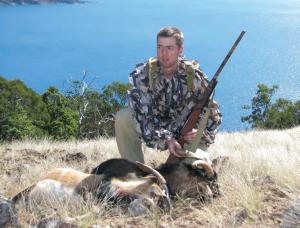
Ben with a couple of goats and his beloved “Pope” gun. (.243 for the uninitiated).
Spotting more goats below us, they were ranged at 178yards. Four shots later three goats didn’t run away with the others, one had to have a finisher so that accounted for the fourth shot. Spotting another goat running across a shale face, I led it by a length and fired. Boom thwack, down it went and we ranged it at 307yards. Shooting steeply downhill, there was no need to hold over and another one was dropped cleanly at a ranged 417yards. Normally, I do not take long shots, but because of the steep angle it was like shooting at 100yards.
Deciding that we would like to walk down to the bay we could see in the distance, Ben and I headed down a winding track for a kilometer and a half and came out onto a beautiful beach. On the way three Billies ran across in front of us and I took one down with the .260Rem, this was probably one of the largest horned goats that we saw. The first thing we found when we hit the sand was Wilson. Nearing the end of the 1.5km beach walk, more goats were spotted looking at us from the rocky face. Sneaking up and around them, another four were culled. Walking even further around the cliffs, we bagged another eight with one on the side of a very steep face and, at the shot, he fell down the cliff and into space, landing with a crash on the rocks below where the tide would take him out when it came in. It was very hot by then as it was midday and a swim was the go. We were having a great time frolicking in the water but if we knew what John was going to tell us we wouldn’t have even gone in. He later told us that in the bay we swum in there was always lots of tiger sharks and they were quick to grab any goats that fell into the sea. That was the end of swimming there.
It took us ages to walk back up the mountain and we were both absolutely knackered by the time we got into camp. Steve and Kiley were already back in camp and grinning from ear to ear as they had had a ball shooting goats off a cliff face where they dropped for many metres into the sea, they had tallied up twenty two while Ben and I had knocked another twenty seven so that had put a fair dent in the population. There is a small herd of rusa deer on the island with a couple of reasonable stags amongst them, but unfortunately, even though we had a fair look for them, the country was that hard and thick we only found a few rub trees and old tracks. Mostly, they hung around near the house and that was an out of bounds area to shoot. Shame, but that’s the way it goes, so we stuck to the goats. It made us all a bit uncomfortable to shoot and leave so many animals, but if we didn’t do it, he would get someone else in to do it instead. The main thing was for us to kill them humanely, as it would be far better then if they were shot at from the air, or boats, where a lot of them would no doubt not be killed cleanly.
We had a great goat satay curry that evening, which we cooked up in the camp oven. This was naturally washed down with liberal amounts of fluids as we watched the campfire burning into the night. John radioed camp that night to let us know that the weather forecast wasn’t good and that we should move camp the following afternoon to the beach ready for a pick up the next morning. A morning’s hunt was planned and daylight found Steve and me out on the rock face on the northern side of the island while Kiley and Ben went to the eastern side. Steve and I cleaned up that morning sending goats tumbling off the steep cliffs into the sea to be eaten by the sharks. We both just about ran out of ammo that morning shooting nearly 40 goats. Getting back to camp, the others had had a productive morning also and cleaned up another 27. This brought our tally up to 146 which was close to the 150 the leaseholders wanted shot. Just after midday we were packed ready for our lift in the quad bike and trailer back to the beach.
Arriving at the beach there were quite a few people there, as Middle Percy Island is a popular safe anchorage for yachts and John introduced us to many of them. They were from all over the place, as they just sail around and drop into different ports and islands as their whims desire. John explained to them what we were doing there and they were all very good about it and knew that the goats were over breeding and had to be culled. That night the boaties invited us to a barbeque on the beach and we met even more of them, when the night was over we had orders for eight goat legs so had to go for a short hunt first thing in the morning. Steve stayed back with our gear waiting for our pick up and the rest of us headed off up the track from the beach towards a steep sand blow. Steep wasn’t the word, it was two steps up and one sliding back and it really took it out of us climbing them. It was blowing a gale and the goats weren’t out and about which made our job a little harder as we really had to search out the sheltered spots. Fortunately we managed to shoot four goats and take most of the legs and shoulders; this also brought our total to near enough to the exact amount that had to be culled, so our job was done to perfection. It was with heavy packs bulging with goat legs we headed back to the beach that morning and some very happy people were waiting to get their ration to cook on board their boats.
Our boat trip home was uneventful, save for it being a rougher trip than the outward sail and some prawns and beer laid on by the skipper. It had been a once-in-a-lifetime experience in a very special place that we will all remember well.









0 Comments